Rubin Vase
A golden vase, or two dark profiles facing each other.

What do you see?
A golden vase on a dark background, with a curvy outline. Or two dark faces in profile, nose to nose, against a golden background. Most people see one first, then suddenly the other. You can switch between them, but you will find it very hard to see both at the same time.
How it works
The Rubin vase is the classic demonstration of figure-ground perception. Every scene must be divided into figures, objects that have shape and seem to stand in front, and ground, the background behind them. The edges in this image can belong to either the vase or the faces, and that choice determines what you see.
The key rule is that an edge belongs to only one side at a time. When the golden region is seen as the figure, the curving outline is the edge of a vase, and the dark regions become shapeless background extending behind it. When the dark regions are seen as figures, the same outline becomes the profile of foreheads, noses, lips and chins, and the golden region becomes background. Because the edge cannot belong to both simultaneously, you see one interpretation or the other, not both.
Several cues influence which interpretation wins. Smaller regions tend to be seen as figures, as do regions that are symmetrical, convex or enclosed. Regions in the lower part of an image are more often seen as figure. Meaningful shapes, such as faces, also tend to attract interpretation as figures, and our sensitivity to faces is so strong that even a rough profile can tip the balance.
Brain imaging has shown that activity in face-sensitive areas of the brain increases when people report seeing the faces rather than the vase, even though the image is unchanged. That is evidence that the switch is not just a matter of how you describe the picture, but a real change in how your brain processes it.
Figure-ground ambiguity is used widely in art and design. Logos often hide a second shape in the background space, and artists such as M. C. Escher built whole prints from interlocking figures that flip between foreground and background. Once you know how figure and ground work, you start seeing these hidden shapes everywhere.
History
Danish psychologist Edgar Rubin introduced the vase-and-faces figure in his 1915 doctoral work on visually perceived figures, and it became central to the Gestalt psychology of perception. Similar images had appeared in puzzle prints before, but Rubin used them to study the rules of figure and ground. This vase and its profiles were drawn for OpticalIllusions.com.
Try it
- Focus on the gold area, then on the dark areas, and watch the image flip.
- Try to see both faces and the vase at once.
- Look at the image upside down: which do you see first?
- Look for hidden figure-ground shapes in logos and posters.
Written by K.R. for OpticalIllusions.com · Updated . Illusion artwork © The Wizard Of Sales, LLC. Feel free to share a link; see our terms for reuse.
Related illusions
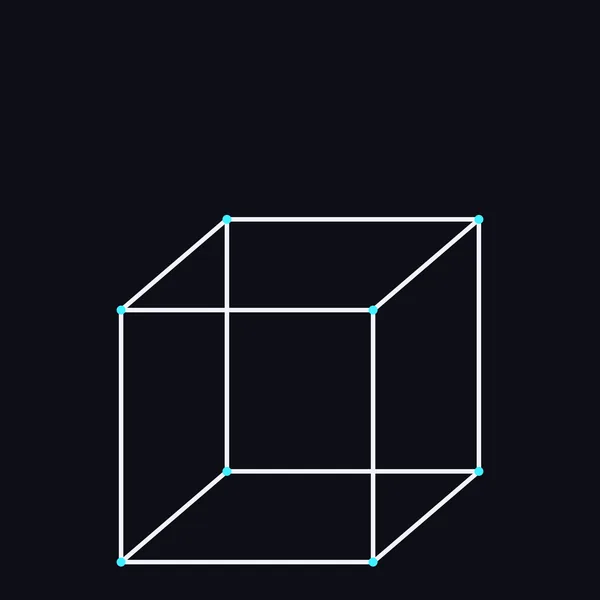 Impossible & ambiguous figuresNecker CubeA wireframe cube that flips between two orientations.
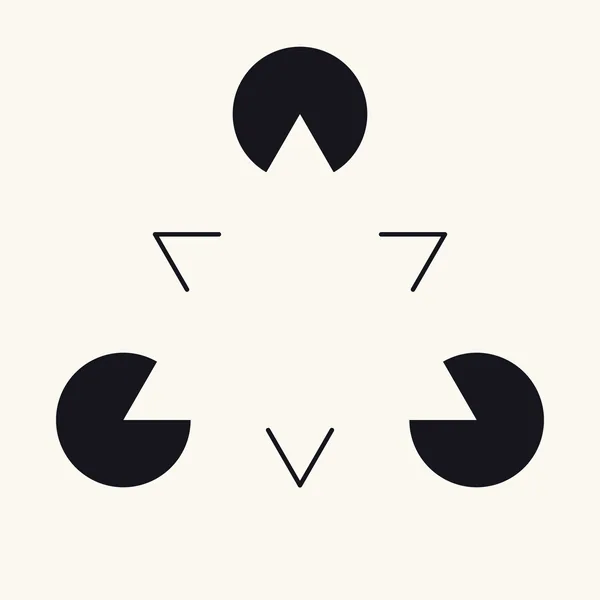 Geometric illusionsKanizsa TriangleA bright white triangle appears from nothing but three cut-out discs.
 Impossible & ambiguous figuresImpossible TriangleThree bars meet at right angles to form a triangle that cannot exist.
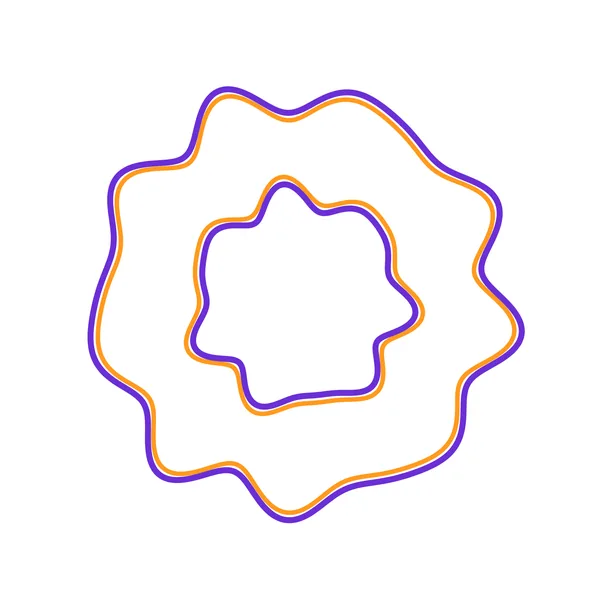 Colour illusionsWatercolour IllusionA thin orange edge tints a whole white region pale orange.