Fraser Spiral
Concentric circles of twisted cord that look like one big spiral.
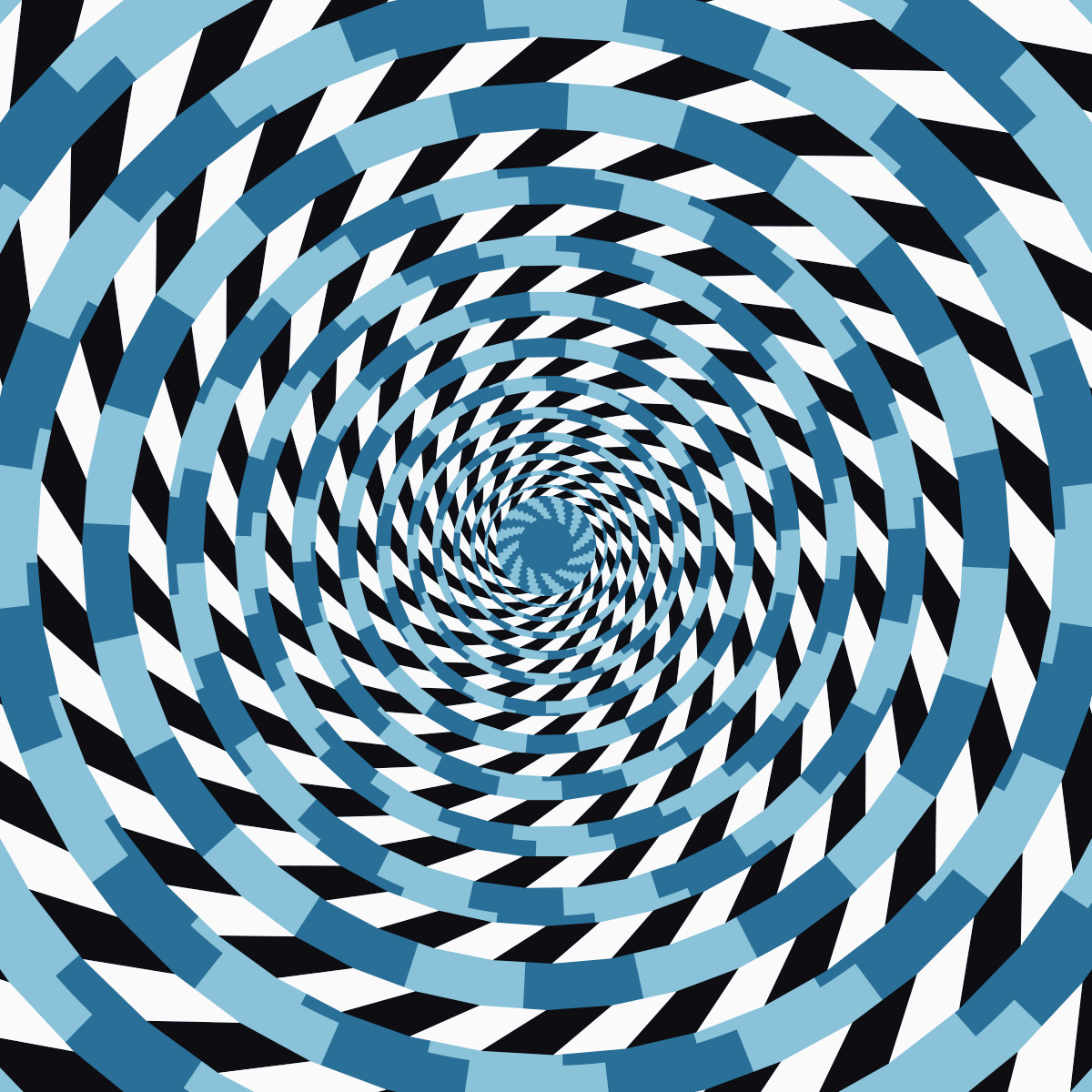
What do you see?
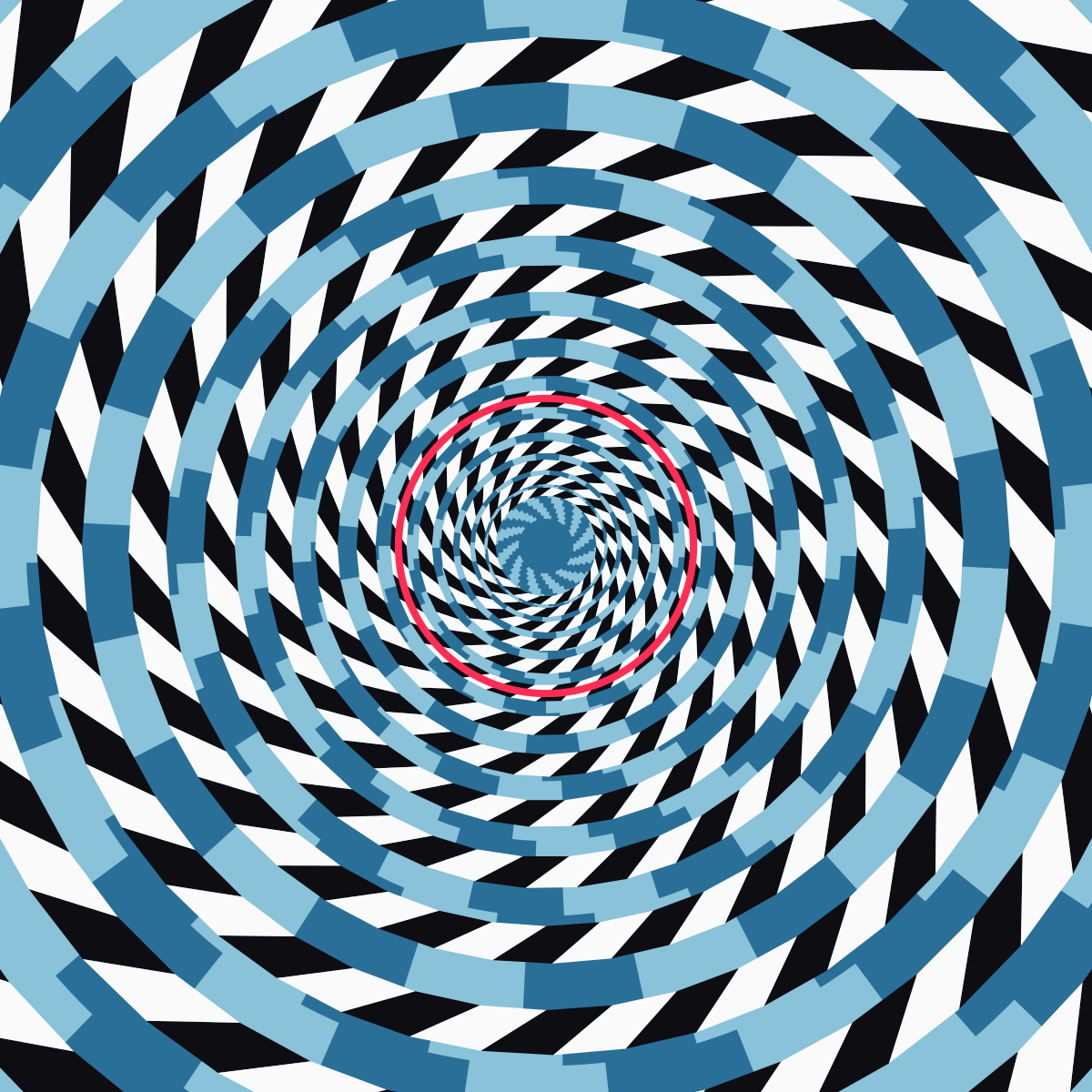
A dizzying spiral that seems to wind inward toward the centre. Try to follow one of the dark-and-light cords with your finger and you will find that it never reaches the middle. Press Reveal to trace one cord: it comes back to where it started. Every cord is a perfect circle centred on the same point.
Get Fraser Spiral on a tee, mug or blanket
Printed to order with the OpticalIllusions.com wordmark.
How it works
The Fraser spiral is a twisted-cord illusion. Each circle is built from short segments that alternate between dark and light and are tilted at a consistent angle to the circle, like the strands of a rope. Each tilted segment, seen alone, suggests a line heading slightly inward or outward.
Your visual system builds long contours by linking local orientations. Neurons in early visual cortex detect the tilt of small edges, and connections between neighbouring neurons group edges that line up into longer curves. Normally this is how you see the outline of an object even when it is partly broken or cluttered. In the Fraser figure, the local signals along each circle all report a tilt pointing slightly toward the centre, so the brain integrates them into a curve that keeps drifting inward: a spiral.
The background adds to the effect. Here the circles sit on a spiral checkerboard whose boundaries reinforce the same twisting direction, and the alternating light and dark of each segment makes the tilt especially prominent. Remove the background, or make all the segments the same colour, and the illusion weakens considerably.
Interestingly, the illusion is mainly a problem of global shape, not local accuracy. If you look closely at any small part of the picture, you can see that it curves correctly. It is only when you take in the whole that the integration error builds into an inward spiral. That is why tracing the path with a finger or a pen, which forces you to follow it locally, reveals the truth.
The Fraser spiral is related to the Café Wall illusion and the Zöllner illusion, in which local tilts make long straight lines look slanted. Here the same principle is applied to curves: tilt is added along the length of each circle until the closed loop no longer looks closed.
Because it involves the way the brain integrates contours, some researchers have used Fraser-type patterns to probe how attention and eye movements build up a global picture from local pieces.
History
British psychologist James Fraser published the illusion in 1908 in a paper on twisted-cord illusions. His original figure, with black-and-white cords on a patterned background, became one of the best-known illusions of the twentieth century. This version, with its own colours and proportions, was drawn for OpticalIllusions.com.
Try it
- Trace a cord with your finger and see it return to its starting point.
- Press Reveal to highlight one circle.
- Zoom in on a small section: up close the curves look correct.
- Step back from the screen: the spiral often becomes even stronger.
Written by K.R. for OpticalIllusions.com · Updated . Illusion artwork © The Wizard Of Sales, LLC. Feel free to share a link; see our terms for reuse.
Related illusions
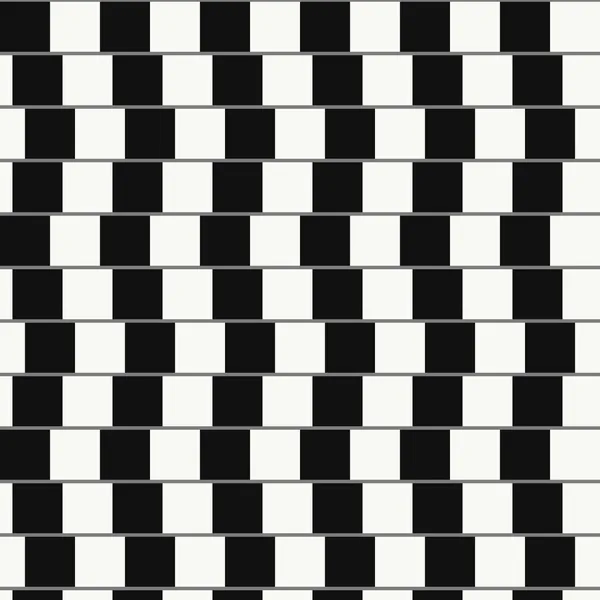 Geometric illusionsCafé Wall IllusionPerfectly parallel rows of tiles that seem to tilt into wedges.
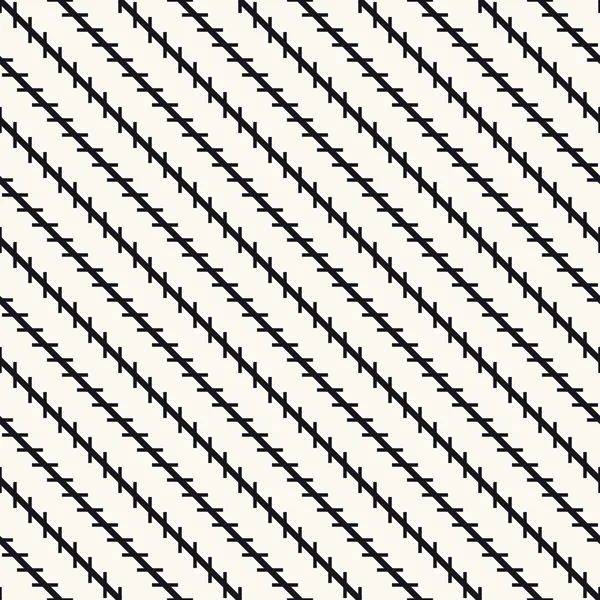 Geometric illusionsZöllner IllusionShort hatches make long parallel lines seem to tilt toward each other.
 Motion illusionsRotating SnakesDiscs that turn on their own, even though nothing moves.
 Motion illusionsPinna-Brelstaff RingsMove your head toward the dot and the two rings turn opposite ways.