Pinna-Brelstaff Rings
Move your head toward the dot and the two rings turn opposite ways.
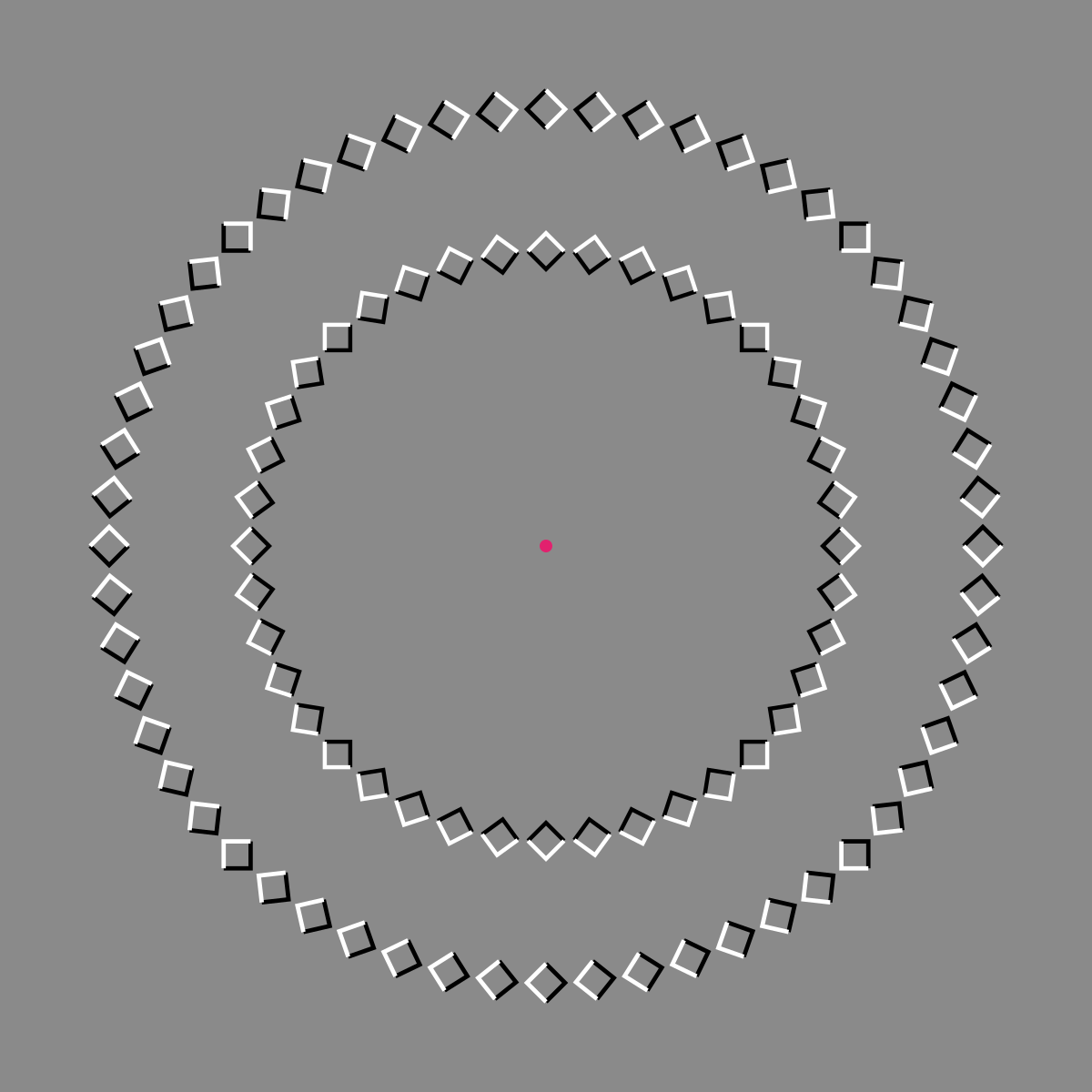
What do you see?
Keep your eyes on the pink dot in the middle. Now move your head slowly toward the screen, then away again. As you approach, the outer ring of little squares seems to rotate one way and the inner ring the other way. Reverse your movement and both rings reverse direction. Stop moving and they stop.
Get Pinna-Brelstaff Rings on a tee, mug or blanket
Printed to order with the OpticalIllusions.com wordmark.
How it works
Every square in the rings has the same structure: two adjacent sides are drawn black and the other two white, against a grey background. The squares in the outer ring are tilted one way relative to the circle, and those in the inner ring are tilted the opposite way. These details turn a simple approaching motion into an apparent rotation.
When you move toward the screen while fixating the centre, the image on your retina expands. Every square moves directly outward from the centre, along a radial line. That is the true motion.
But motion detectors in early vision see each square only through a small window and respond mainly to the edges inside it. As with the aperture problem described in the Ouchi illusion, a detector looking at a straight edge can only register motion perpendicular to that edge. Because the squares are tilted, their edges are not perpendicular to the radial direction, so the local motion signals point partly sideways, along the ring, as well as outward.
The black and white sides add a second ingredient. The pairing of a dark edge and a light edge on opposite sides creates a consistent polarity that biases the detectors further, so the sideways component is not cancelled out by the other edges of the square. Across the whole ring, these sideways biases all point the same way around the circle. The brain combines them into a global rotation. The inner ring's squares are tilted the opposite way, so its sideways signals add up to rotation in the opposite direction.
Research using brain imaging has found that higher motion areas, which integrate local signals into global patterns such as rotation and expansion, respond to this display as if it contained real rotation. That suggests the illusion arises when the brain pools many slightly misleading local measurements into one confident conclusion.
The effect needs motion of some kind. A still head gives a still image, so nothing turns. That is a useful contrast with the rotating snakes, which seem to move even when you hold perfectly still.
History
Italian vision scientist Baingio Pinna and Gavin Brelstaff described this illusion in the journal Vision Research in 2000. It has been studied widely as an example of how local motion signals are combined into global motion. This version was drawn for OpticalIllusions.com.
Try it
- Fix on the dot and move your head slowly forward and back by about a hand's width.
- On a phone, hold the screen still and move it toward and away from your face instead.
- Try faster and slower movements: the rotation speed follows your speed.
- Look away from the dot while moving and the effect usually weakens.
Written by K.R. for OpticalIllusions.com · Updated . Illusion artwork © The Wizard Of Sales, LLC. Feel free to share a link; see our terms for reuse.
Related illusions
 Motion illusionsRotating SnakesDiscs that turn on their own, even though nothing moves.
 Motion illusionsOuchi IllusionA checkered disc that seems to float and slide over its background.
 Geometric illusionsFraser SpiralConcentric circles of twisted cord that look like one big spiral.
 InteractiveMotion illusionsStereokinetic RingsTurning flat circles that suddenly pop out as a cone or tunnel.