Motion Aftereffect Spiral
Watch a spinning spiral for 30 seconds and still things start to move.
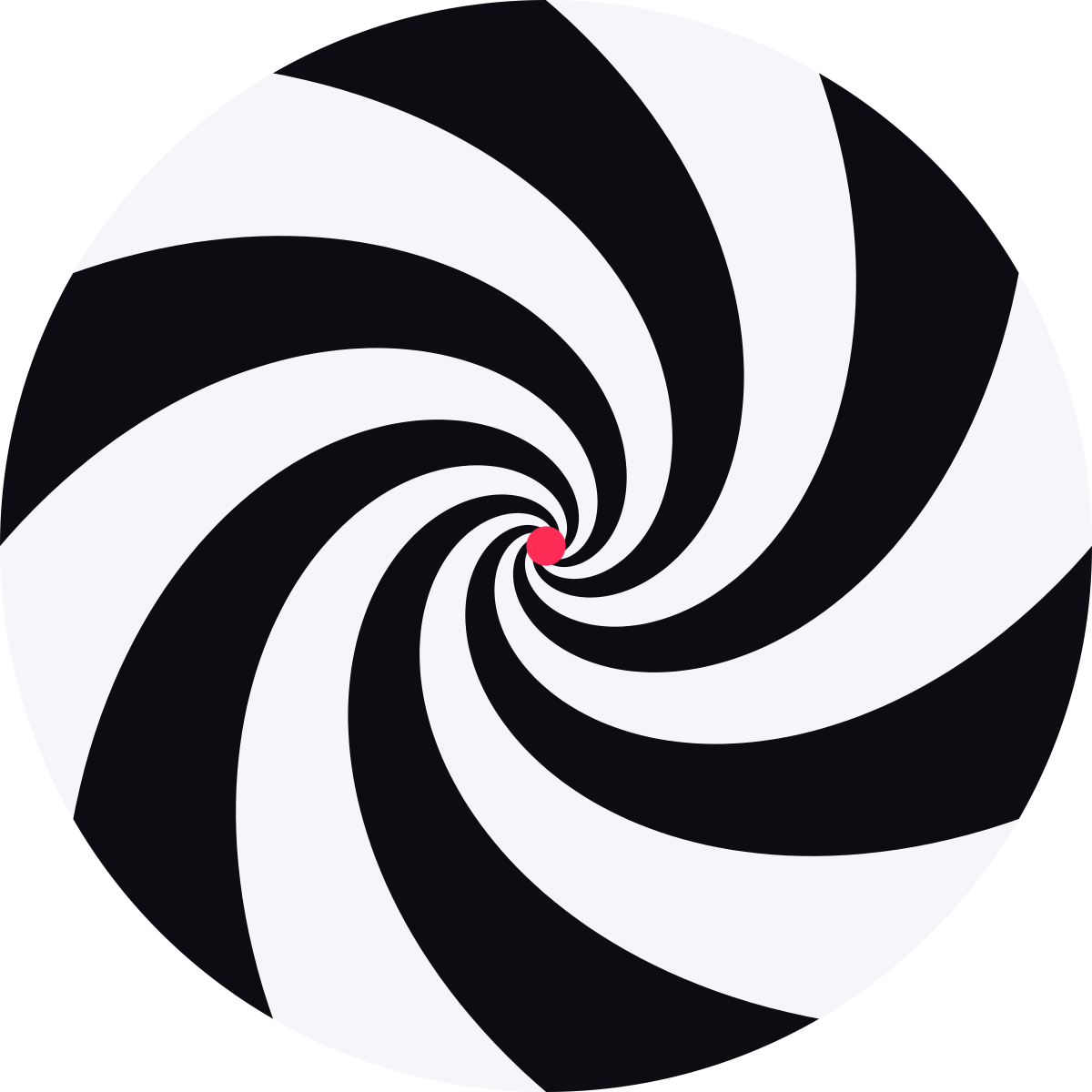
What do you see?
Press start and keep your eyes on the red dot in the middle of the turning spiral for thirty seconds. When it stops, look at the still spiral, the text on this page, or the back of your hand. For a few seconds everything seems to swell outward or shrink inward, the opposite of what the spiral was doing, even though nothing is moving at all.
Get Motion Aftereffect Spiral on a tee, mug or blanket
Printed to order with the OpticalIllusions.com wordmark.
How it works
This is the motion aftereffect, one of the oldest and most reliable illusions in vision science. It reveals that your brain does not have a single detector that measures motion directly. Instead, it compares the activity of many populations of neurons, each tuned to a particular direction.
In the visual cortex, especially an area called MT (also known as V5), there are neurons that fire most strongly for motion in one direction: some prefer up, some down, some outward expansion, some inward contraction. When you look at something still, these opposing groups fire at a low, balanced background rate, and the balance reads as zero motion.
While you stare at the spinning spiral, the neurons tuned to its direction fire hard for half a minute. Like any hard-working cell, they adapt: their response weakens, partly through fatigue and partly through active gain control that keeps the system sensitive to change. When the spiral stops, the adapted neurons fall below their normal resting rate, while the neurons tuned to the opposite direction are fresh. The balance tips, and the brain reads the imbalance as motion in the reverse direction.
A spiral is a powerful adapter because its rotation is seen locally as expansion or contraction. That is why the aftereffect transfers so well to faces and hands, which are not spirals at all: the adaptation is about the direction of motion in each patch of the visual field, not about the shape that caused it.
Some curious details support this explanation. The aftereffect is usually limited to the part of the visual field that was adapted, so if you keep your gaze on the dot, only the region the spiral covered will appear to move. It also has a paradoxical feel: things appear to move without changing position, which tells us that the brain's sense of motion and its sense of location are computed partly separately. The effect fades over several seconds as the neurons recover.
History
Aristotle described a version of it, and the Czech scientist Jan Purkinje noted it after watching a cavalry parade. The best-known early report came from Robert Addams in 1834, who stared at the Falls of Foyers in Scotland and then saw the rocks beside the waterfall drift upward, which is why it is often called the waterfall illusion. In 1849 Joseph Plateau used a rotating spiral to produce it, the same design used here.
Try it
- Sit about an arm's length from the screen and keep your gaze on the red dot the whole time.
- Try it again with the direction reversed and watch the aftereffect reverse too.
- After the spin stops, look at a patterned rug or a bookshelf: textured surfaces show the effect best.
- If you are sensitive to motion or feel unwell, skip this one.
Written by K.R. for OpticalIllusions.com · Updated . Illusion artwork © The Wizard Of Sales, LLC. Feel free to share a link; see our terms for reuse.
Related illusions
 InteractiveMotion illusionsStereokinetic RingsTurning flat circles that suddenly pop out as a cone or tunnel.
 InteractiveColour illusionsAfterimage FlagStare at a cyan, black and yellow flag and a red, white and blue one appears.
 InteractiveMotion illusionsTroxler FadingStare at the cross and the soft colour spots vanish into grey.
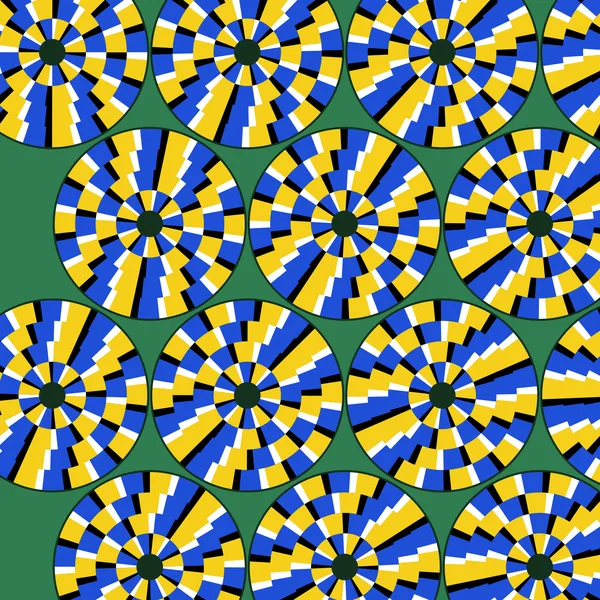 Motion illusionsRotating SnakesDiscs that turn on their own, even though nothing moves.