Stereokinetic Rings
Turning flat circles that suddenly pop out as a cone or tunnel.
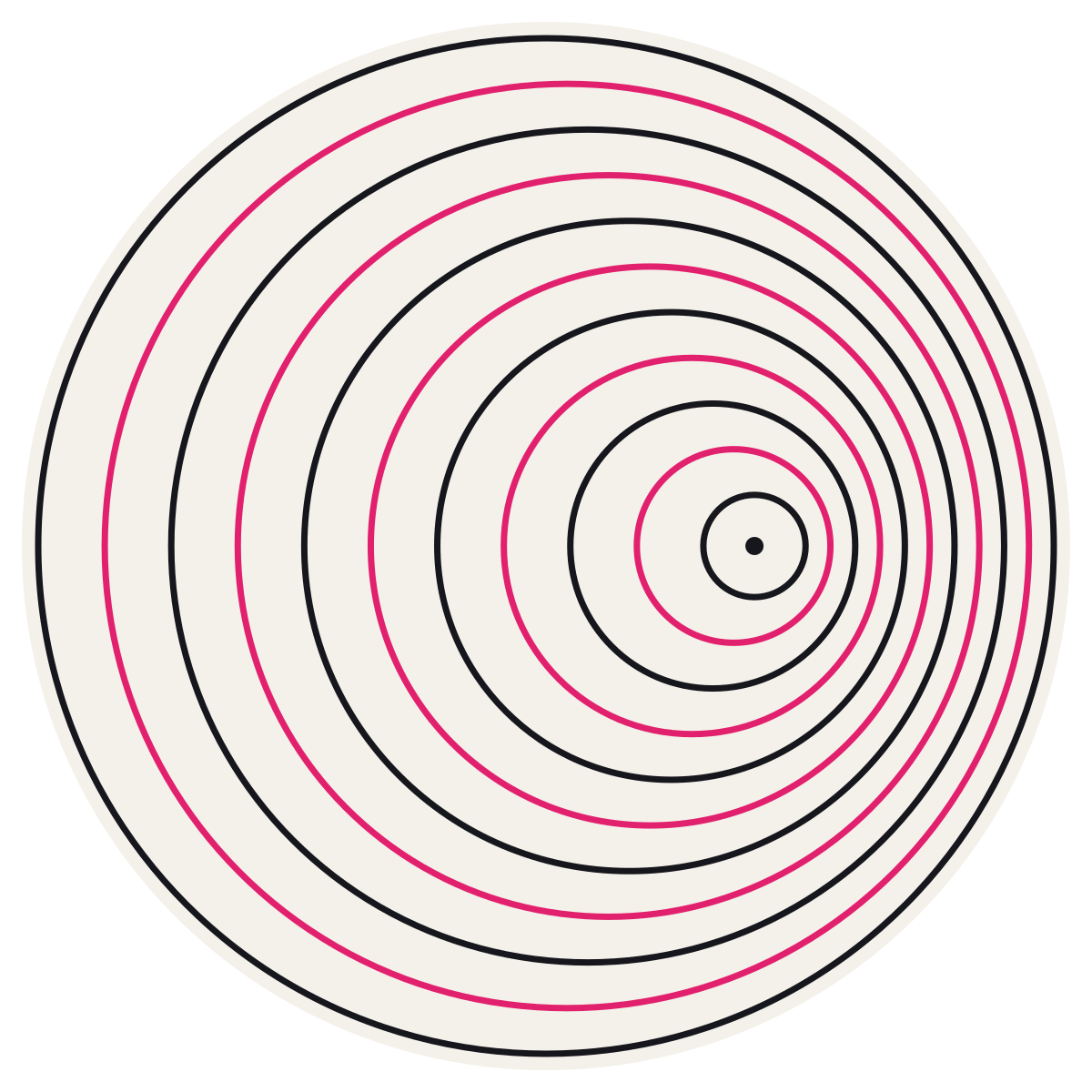
What do you see?
Press play and watch the slowly turning disc of circles. At first it looks like what it is: flat rings drawn off-centre, rotating on a turntable. Keep watching for ten or twenty seconds. Suddenly the rings stop looking flat. They become a cone pointing toward you, or a tunnel stretching away, swaying gently as it turns. Some people find it flips between the two.
Get Stereokinetic Rings on a tee, mug or blanket
Printed to order with the OpticalIllusions.com wordmark.
How it works
This is the stereokinetic effect: depth that appears purely from motion, with no stereo vision required. It works just as well with one eye closed, and it shows how strongly the brain prefers rigid three-dimensional objects over flat shapes that warp.
Look at what actually happens on screen. Each circle is rotated as a whole around the centre of the disc, so its own centre travels in a small orbit. But a circle has no visible markings, so your visual system cannot tell whether the circle is turning or just sliding. The most economical interpretation is that each circle is sliding around without rotating, and that the circles are shifting relative to one another. Relative sliding like that is exactly what you see when you look at the rings of a cone or tunnel that is wobbling in space.
So the brain is faced with two descriptions of the same motion. In one, a flat set of circles slides around in a slightly odd way. In the other, a single rigid object, a cone with stacked rings, rotates in depth and stays the same shape. Perception tends to pick the interpretation in which objects keep a constant shape, a bias sometimes called the rigidity assumption, because real objects rarely melt as they move. Once the cone interpretation wins, depth appears vividly, even though there is no shading, perspective or binocular disparity at all.
The depth is ambiguous in sign. Nothing in the motion says whether the innermost ring is nearer or farther than the outer rings, so the cone can be seen pointing out or pointing in. That ambiguity is why the shape can flip, much like the Necker cube.
The effect also takes time to build. Studies have found that observers often need several seconds of viewing before depth appears, and the perceived height of the cone can grow with continued watching, as if the brain gradually commits to the three-dimensional solution.
History
The effect was studied in the 1920s by the Italian psychologists Vittorio Benussi and Cesare Musatti, who coined the term stereokinetic. Around the same time the artist Marcel Duchamp made his Rotoreliefs, discs designed to be spun on a record player to create the same uncanny depth. The disc on this page was drawn for OpticalIllusions.com.
Try it
- Give it at least 15 seconds: the depth often arrives suddenly.
- Close one eye. The cone stays, which proves this is not stereo vision.
- Use the speed control: very slow rotation makes the cone easier to see for many people.
- Try to flip the cone from pointing out to pointing in by imagining the centre ring far away.
Written by K.R. for OpticalIllusions.com · Updated . Illusion artwork © The Wizard Of Sales, LLC. Feel free to share a link; see our terms for reuse.
Related illusions
 InteractiveMotion illusionsMotion Aftereffect SpiralWatch a spinning spiral for 30 seconds and still things start to move.
 Impossible & ambiguous figuresNecker CubeA wireframe cube that flips between two orientations.
 InteractiveMotion illusionsMoiré PatternsTwo sets of rings overlap and phantom waves sweep across them.
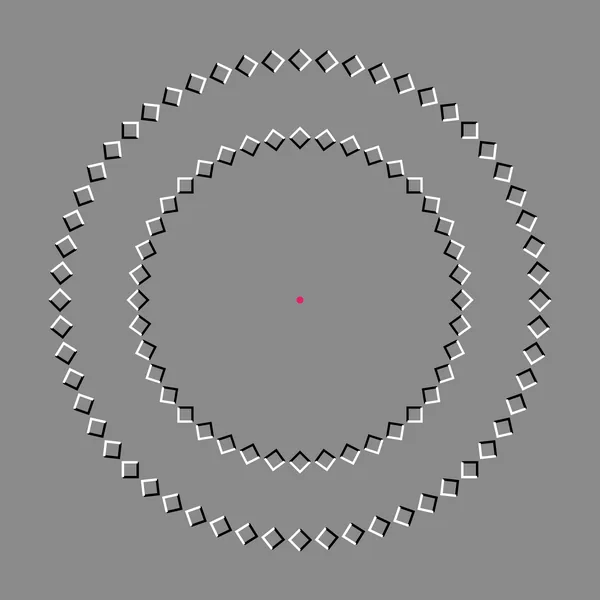 Motion illusionsPinna-Brelstaff RingsMove your head toward the dot and the two rings turn opposite ways.