Ouchi Illusion
A checkered disc that seems to float and slide over its background.
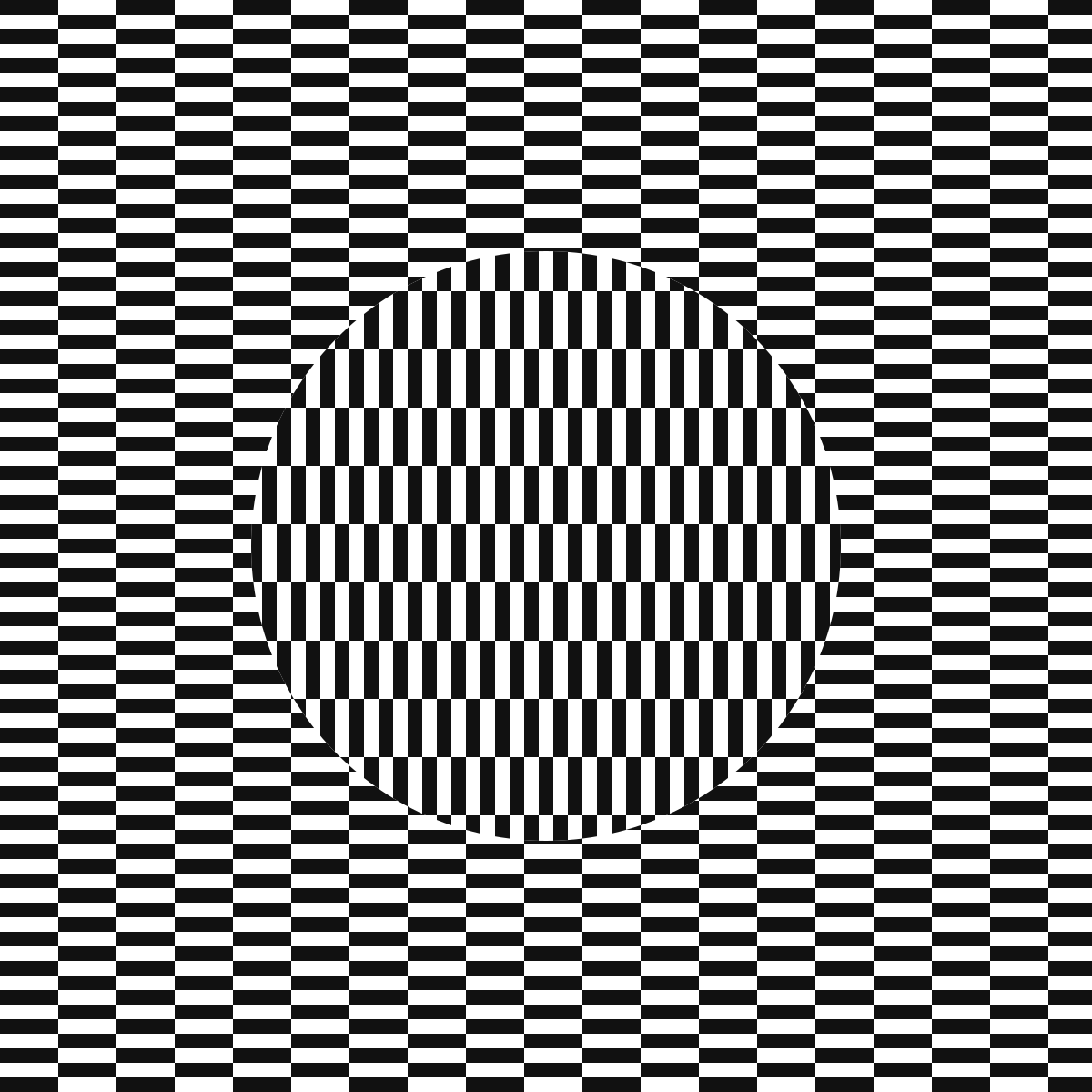
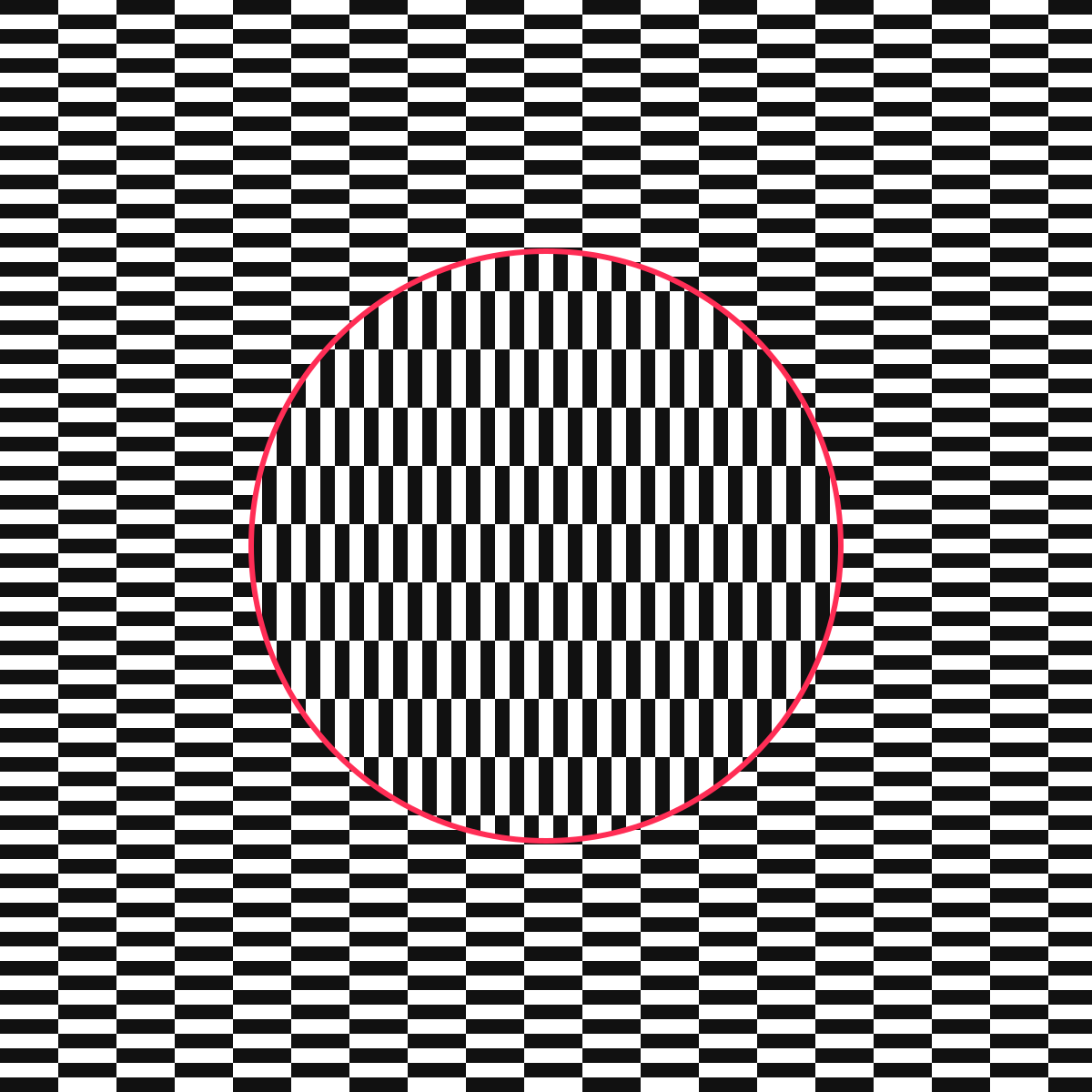
What do you see?
A disc of upright black-and-white bricks sits in a sea of sideways bricks. Move your eyes or gently shake the screen and the disc seems to come loose from the page, floating above the background and sliding back and forth on its own. Many people also see it sitting at a different depth, like a coin resting on a patterned tablecloth.
Get Ouchi Illusion on a tee, mug or blanket
Printed to order with the OpticalIllusions.com wordmark.
How it works
The disc and the surround are made of the same elements, long thin rectangles in a checkerboard, but they are rotated ninety degrees relative to each other. That single change is enough to split the picture into two layers that your visual system then treats as separate objects.
The key is a problem every motion detector faces, called the aperture problem. A neuron in early visual cortex looks at only a tiny patch of the scene. If that patch contains a long straight edge, the neuron can only tell how the edge moves perpendicular to itself; any movement along the edge is invisible to it. Long horizontal bricks therefore report vertical motion very reliably and horizontal motion very poorly. Upright bricks do the opposite.
Your eyes are never perfectly still. Even when you think you are fixating, small drifts and micro-saccades shift the image across the retina in every direction. With an ordinary picture, every region reports the same shift and the brain correctly concludes that the eyes moved, not the world. In the Ouchi figure, the surround picks up the vertical part of each eye movement and the disc picks up the horizontal part. The two regions report different motion for the same eye movement, and the simplest interpretation is that one of them is actually moving relative to the other. Because the surround is larger, the brain tends to treat it as the stable background and assigns the extra motion to the disc, so the disc appears to float and jitter.
The depth impression comes from the same segmentation. Once the disc is grouped as its own surface with a clean circular border, cues that usually signal occlusion kick in, and the disc is seen as lying in front of or behind the background.
Research has shown that the illusion grows stronger when the rectangles are more elongated and weaker when they become squares, which fits the aperture account neatly: squares give no orientation bias, so there is nothing to disagree about.
History
The pattern is named after Japanese artist Hajime Ouchi, who included it in his 1977 book of optical and geometrical art. Vision scientists, including Lothar Spillmann and colleagues, later used it to study how the brain separates figure from ground and how orientation affects motion signals. This version was drawn for OpticalIllusions.com with its own proportions.
Try it
- Scroll the page up and down slowly while looking near the disc: it slides against the surround.
- Hold your phone at arm's length and give it a small circular wobble.
- Press Reveal to outline the disc; the edge does not move, but the inside still seems to.
Written by K.R. for OpticalIllusions.com · Updated . Illusion artwork © The Wizard Of Sales, LLC. Feel free to share a link; see our terms for reuse.
Related illusions
 Motion illusionsRotating SnakesDiscs that turn on their own, even though nothing moves.
 InteractiveMotion illusionsMoiré PatternsTwo sets of rings overlap and phantom waves sweep across them.
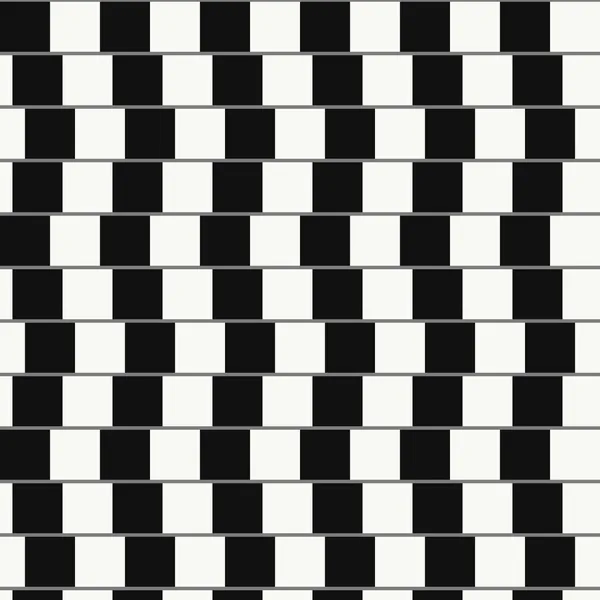 Geometric illusionsCafé Wall IllusionPerfectly parallel rows of tiles that seem to tilt into wedges.
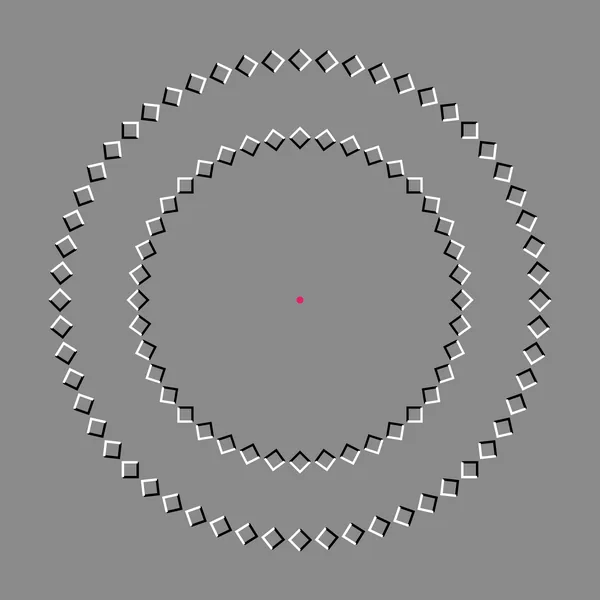 Motion illusionsPinna-Brelstaff RingsMove your head toward the dot and the two rings turn opposite ways.