Hermann Grid
Grey smudges flicker at the crossings of a black-and-white grid.
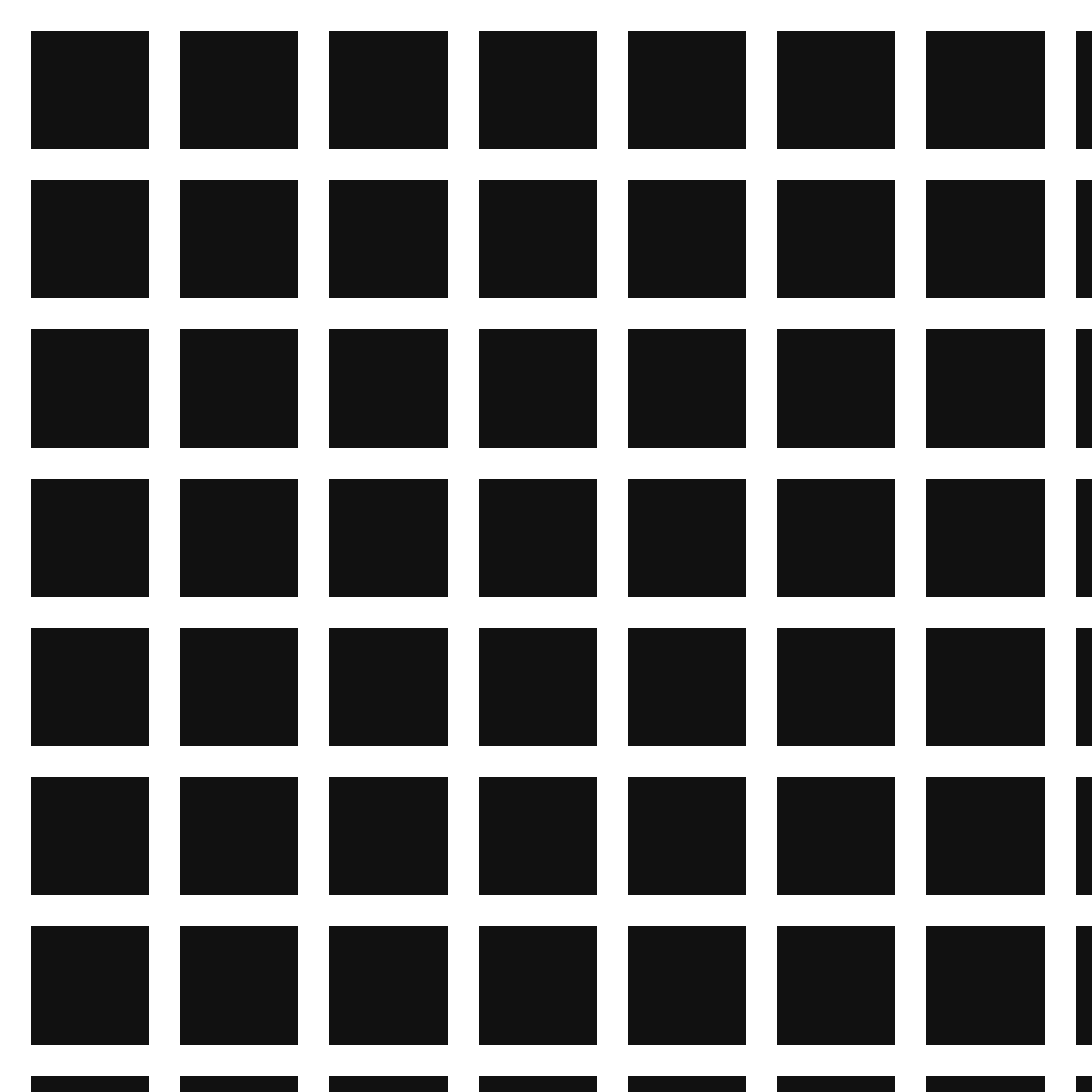
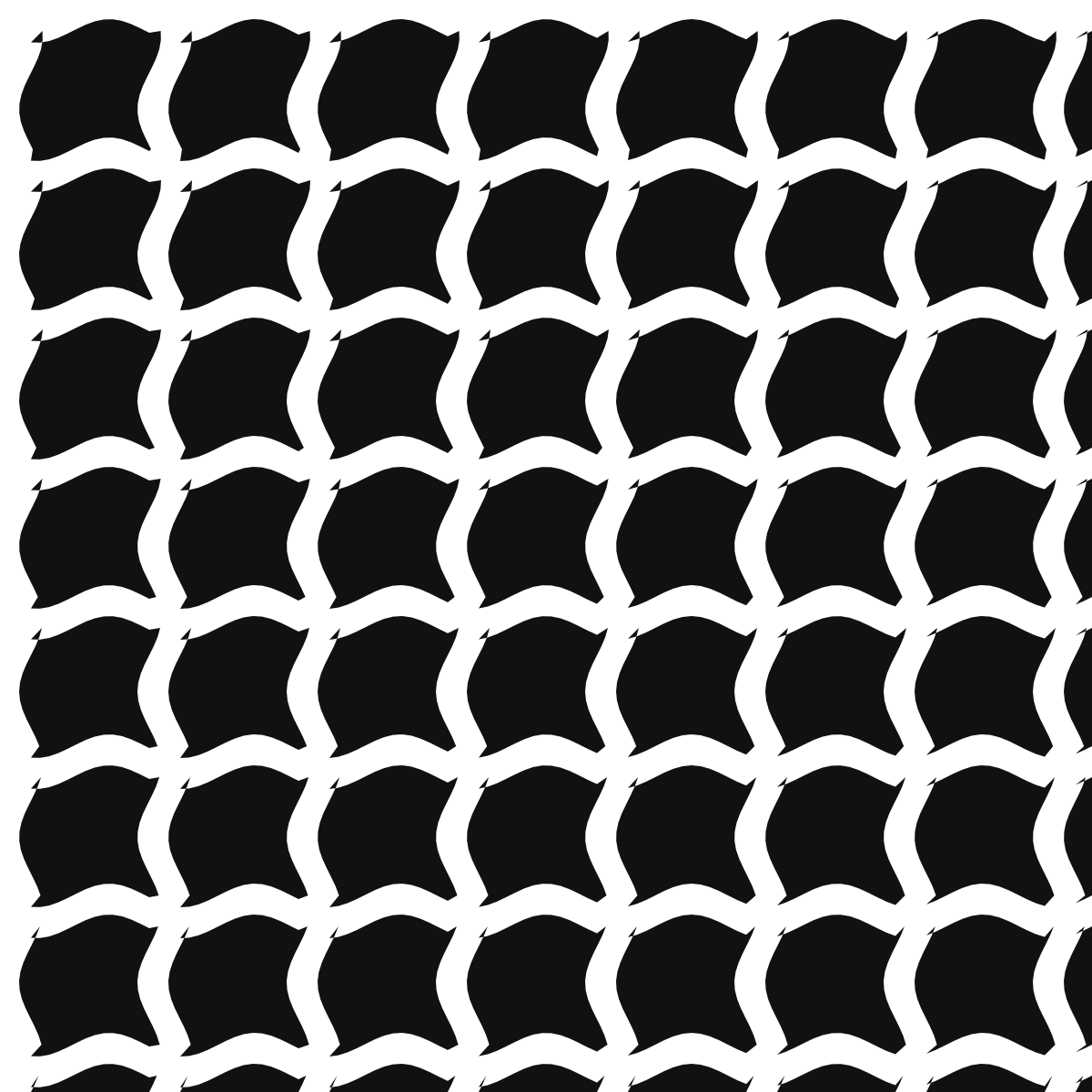
What do you see?
A grid of black squares separated by white streets. At the crossings, faint grey smudges appear, like shadows at the corners of a city block. Try to look straight at one and it vanishes, only for others to appear in the corner of your eye. Press Reveal to make the streets wavy, and most people find the ghosts disappear completely.
How it works
For decades the Hermann grid was the textbook example of lateral inhibition, a process in which neighbouring neurons in the retina suppress each other. Retinal ganglion cells have centre-surround receptive fields: light in the centre excites the cell, light in the surrounding ring inhibits it. A cell centred on a street sees white in its centre and white on two sides of its surround. A cell centred on a crossing sees white in its centre and white on all four sides. More light in the surround means more inhibition, so the crossing cell fires less and the crossing looks darker. The smudges vanish when you look directly at them because central vision uses much smaller receptive fields that fit inside the street, so the surround sees no extra white.
That story is elegant, and it explains the basic effect. But in 2008 a team led by János Geier showed that bending the streets into gentle waves almost completely destroys the illusion, even though the amount of white around each crossing is essentially unchanged. A simple retinal explanation predicts that the wavy grid should work just as well. It does not, which suggests that the classic account is incomplete.
Researchers including Peter Schiller and Christina Carvalho have argued that orientation-selective neurons in the visual cortex play a key role. These cells respond best to straight edges at particular angles. In a straight grid, the long straight edges of the streets are strongly signalled, but the crossings, where edges meet from four directions, are processed differently, and the brain's estimate of their brightness is lowered. When the edges curve, that pattern of responses changes and the dark spots no longer form.
So the Hermann grid is now understood as a mix of retinal and cortical processing: centre-surround interactions set the stage, and orientation-tuned mechanisms in cortex determine whether the illusion appears. It is a good example of how a famous explanation can be partly right and still be overturned by a well-chosen variation.
The effect also depends on size and contrast. It is strongest when the streets are thin compared with the squares and when the squares are much darker than the streets. Reverse the colours, white squares on black streets, and light smudges appear at the crossings instead.
History
German physiologist Ludimar Hermann reported the effect in 1870 after noticing it in a figure in a book by the physicist John Tyndall. Ewald Hering later described the reversed version. The wavy variation that challenged the textbook account was published in 2008. The grids here were drawn for OpticalIllusions.com.
Try it
- Let your eyes roam across the grid and count the ghosts.
- Stare at one crossing: it stays clean while others turn grey.
- Press Reveal for the wavy grid and compare.
- Move closer or farther away to find the distance where the effect is strongest.
Written by K.R. for OpticalIllusions.com · Updated . Illusion artwork © The Wizard Of Sales, LLC. Feel free to share a link; see our terms for reuse.
Related illusions
 Brightness illusionsScintillating GridWhite dots on a grey grid seem to flash with black spots.
 InteractiveBrightness illusionsSimultaneous ContrastA uniform grey bar looks lighter on the left and darker on the right.
 InteractiveBrightness illusionsCornsweet IllusionLeft and right halves are the same grey, but the left looks lighter.
 Geometric illusionsCafé Wall IllusionPerfectly parallel rows of tiles that seem to tilt into wedges.