Ponzo Illusion
Two equal bars on converging rails look like different lengths.
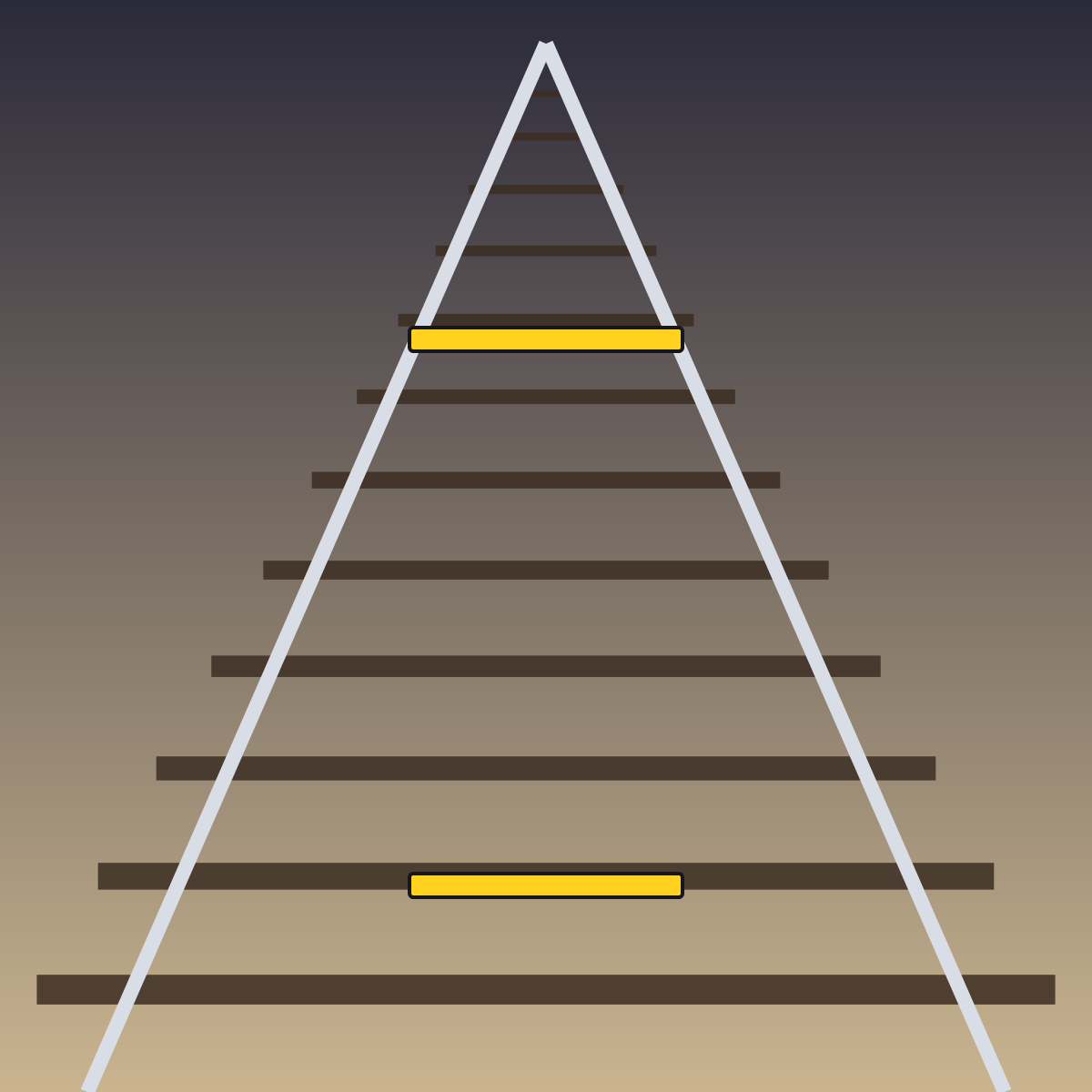

What do you see?
A railway track runs away from you toward the horizon. Two yellow bars lie across it. The upper bar, farther down the line, looks clearly longer than the lower one near the bottom of the picture. Press Reveal to take away the track: the two bars are identical.
How it works
Converging lines are one of the strongest depth cues your visual system knows. Real parallel edges, such as rails, road verges and hallway walls, project onto the retina as lines that meet in the distance. When the brain sees two lines converging, it treats the region near the meeting point as farther away.
Now consider the two bars. They have the same size on the page, and therefore the same size on your retina. But one appears to sit far down the track and the other close by. The brain applies size constancy: an object far away that casts the same retinal image as a nearby object must be physically larger. So the distant bar is perceived as longer. This scaling happens automatically and does not need the scene to look realistic. Two plain converging lines, with no sleepers or shading, are enough to produce the effect, which is why the classic version is just a pair of slanted lines like the letter A with its top cut off.
A complementary explanation focuses on the space around each bar. The upper bar nearly fills the gap between the rails, while the lower bar leaves a lot of empty space on either side. Judging a length relative to the frame it sits in makes the upper bar look larger, in the same way as the Ebbinghaus circles. Both factors probably contribute, and their relative strength can be teased apart by changing the figure.
Evidence from developmental and cross-cultural studies suggests experience matters. Some research has found the illusion weaker in people who grew up with fewer long straight roads and perspective views, though results vary. Studies with animals, including pigeons and monkeys, have found Ponzo-like effects, suggesting that the underlying tendency to read convergence as depth is widespread in visual systems.
Artists have exploited the effect for centuries. Linear perspective, formalised in the Renaissance, works because the same rules your brain uses to read the Ponzo figure also turn a flat painting into a convincing deep space.
History
Italian psychologist Mario Ponzo described the illusion in 1911, showing that identical lines drawn across converging lines appear unequal. It is closely related to the moon illusion, in which the moon near the horizon appears much larger than when it is high in the sky. The scene here was drawn for OpticalIllusions.com.
Try it
- Press Reveal and compare the bars on a plain background.
- Turn your phone upside down: the bar nearest the vanishing point still looks longer.
- Hold two fingers against the screen to mark the ends of one bar, then slide them to the other.
- Look for Ponzo effects in photos of roads, corridors and runways.
Written by K.R. for OpticalIllusions.com · Updated . Illusion artwork © The Wizard Of Sales, LLC. Feel free to share a link; see our terms for reuse.
Related illusions
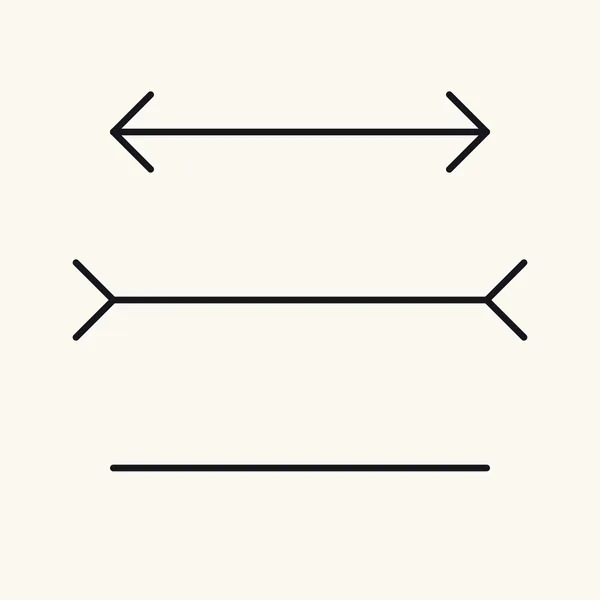 InteractiveGeometric illusionsMüller-Lyer IllusionThree identical lines that look clearly different in length.
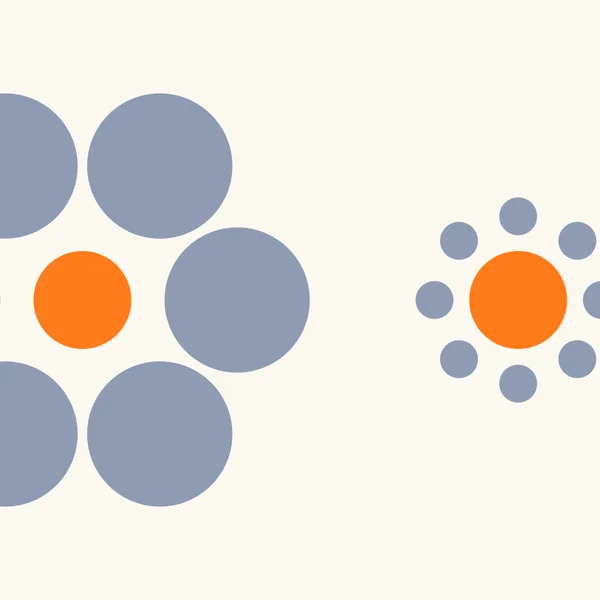 Geometric illusionsEbbinghaus IllusionA circle among giants looks small; among dwarfs it looks big.
 Geometric illusionsJastrow IllusionTwo identical arcs, but the lower one always looks bigger.
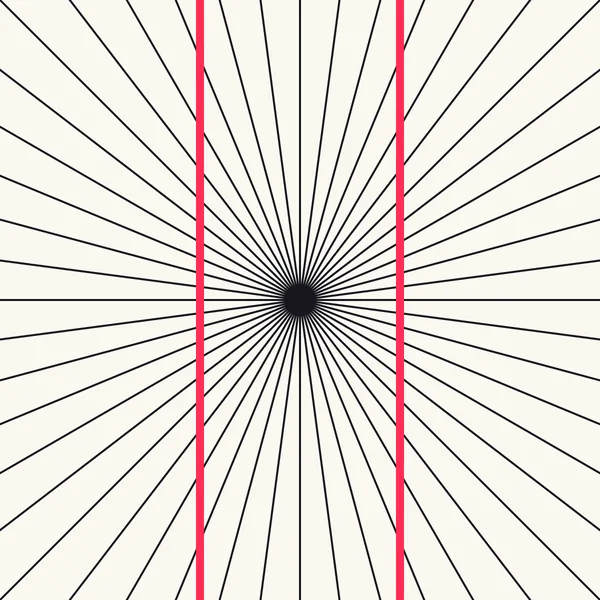 Geometric illusionsHering IllusionTwo straight red lines bulge apart over a burst of rays.